Most people meet makhana as a light, white, crunchy snack sold in a pouch. Few see the work behind it. Every kernel in that pouch started as a hard black seed lying in the mud at the bottom of a pond in north Bihar, and it passed through several pairs of hands before it was ready to eat.
Bihar grows most of India's makhana, with commonly cited figures putting its share at around 85 to 90 percent. The crop is concentrated in the Mithila and Kosi belt: Darbhanga, Madhubani, Purnea, Katihar, Kishanganj, Araria, Saharsa and Supaul. In 2022 Mithila Makhana received a Geographical Indication tag, which formally links the product to this region and to the way it has long been grown and processed here.
Where the crop grows
Makhana is the seed of Euryale ferox, a water plant with large, thorny leaves that float flat on the surface. Traditionally it grows in ponds, oxbow lakes and low-lying wetlands that hold water for most of the year. The plants flower and set fruit through the warm months. When the fruits ripen they burst underwater and the seeds sink and settle into the pond bed.
Over the last several years, farmers around Purnea have also taken up field cultivation, known locally as khet makhana. A shallow layer of water is held in bunded fields and the crop is managed much like paddy. Pond and field crops reach the market side by side.
Harvest: hand work, underwater
Collecting the seed is the hardest part of the whole process. Divers, very often from the Mallah community, who have done this work for generations, go down to the pond bed and gather the seed along with the silt around it. They surface, empty their haul into a basket, and go down again. Dozens of dives in a day are normal in season.
Once ashore, the seeds are washed and sieved to clear mud and plant debris, then spread out to dry in the sun. Drying brings the moisture down so the seed stores well, and the dried seed is sorted by size so each batch roasts evenly.
Roasting and popping
This is the stage that gives makhana its shape. The sorted seeds are roasted in shallow iron pans over a wood or coal fire, usually in more than one round, with rest periods in between so the heat works right through the kernel. The roaster keeps the seeds moving the whole time. Too little heat and the kernel will not expand. Too much and it scorches.
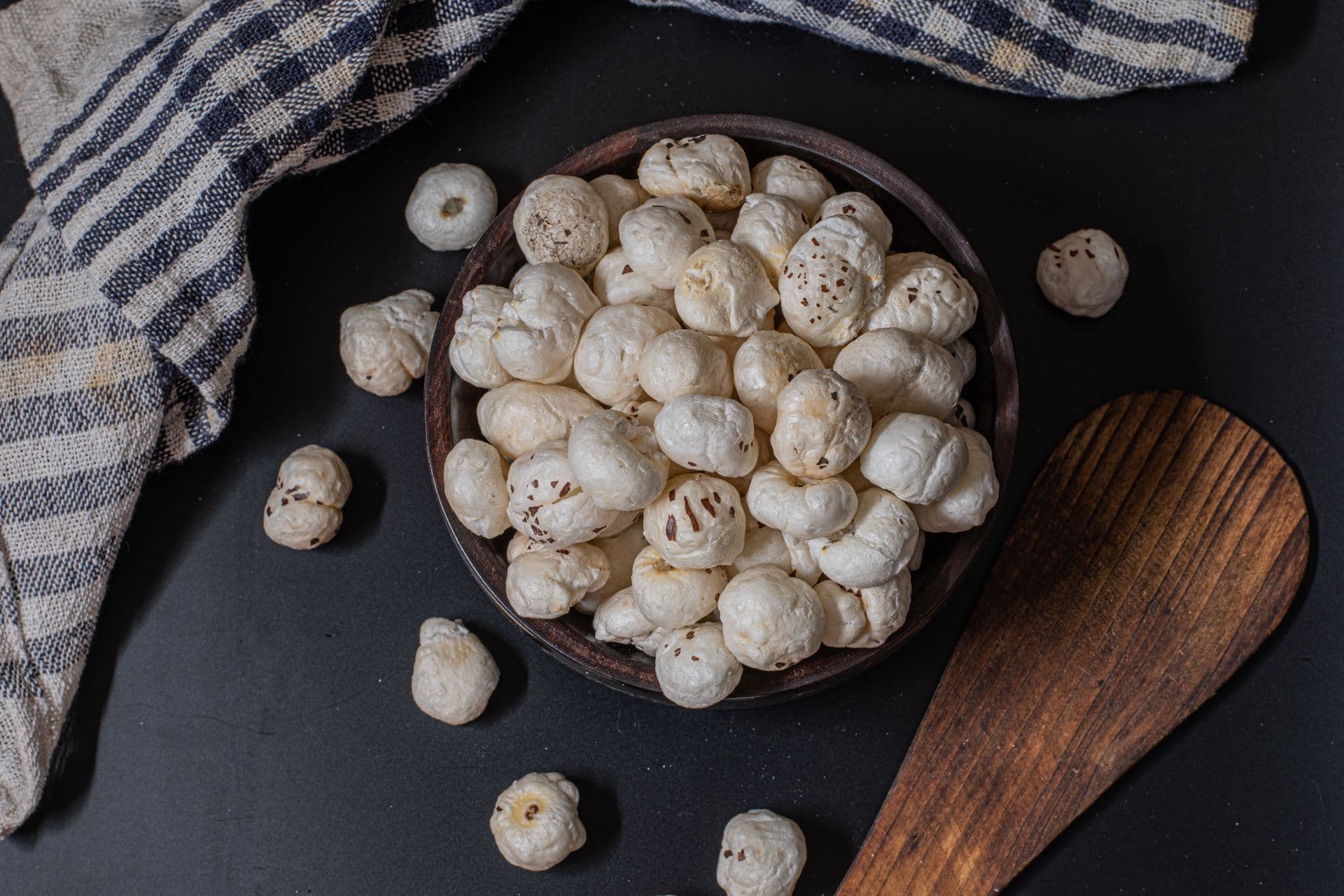
At the right moment, while the seeds are still hot, a worker scoops up a handful and strikes them with a wooden mallet on a hard surface. The shell cracks, the kernel puffs out, and what comes free is the white, airy piece people recognise. It happens in a second or two. A good worker repeats it thousands of times a day with very few broken pieces, and the quality of a batch depends heavily on that skill.
The pond decides how much makhana there will be. The hands at the fire decide how good it will be.
How makhana is graded
After popping, the kernels are sorted by diameter. The trade measures this in suta, a traditional unit of about an eighth of an inch. You will see lots described as 4 suta, 5 suta, and 6 suta and above. Larger pops fetch higher prices and usually go into premium retail packs and roasted, flavoured snacks. Smaller grades are widely used in cooking, in mixes and for grinding into flour.
What buyers should check
A grade name on an invoice is only a starting point. Before accepting a lot, check a sample against the following.
- Size uniformity. A 5 suta lot should look like 5 suta all the way through, not large pieces on top and smaller ones further down the bag.
- Colour. Good makhana is white to off-white. A few brown patches left by the shell are normal, but heavy browning or dark spots suggest poor roasting or old stock.
- Crunch and moisture. A kernel should break cleanly with a dry snap. If it bends, feels chewy or smells musty, it has picked up moisture.
- Un-popped seed. Hard, dark seeds that never opened add weight but no value. Agree an acceptable share in writing before the order is confirmed.
- Packing. Makhana is light and takes up moisture easily, so look for sealed food-grade liners inside the outer bag or carton, and clear batch labels.
Hand-sorting a few hundred grams from different parts of a bag will tell you most of what you need to know about a lot.
How O Farm supplies makhana
O Farm (Overseas Farm Private Limited) is based in Gulabbagh, Purnea, in the middle of the makhana belt. We buy directly from growers and farmer producer organisations, and we pay against quality, so farmers who bring in clean, well-dried seed are paid for that care. Processing happens close to where the crop is harvested.
Every lot is graded by suta size and packed in batches that can be traced back to their source. For a buyer, that means the delivery matches the sample you approved, with a clear record of where the product came from.
If you need graded makhana for retail packing, roasting, food service or export, we can share current grades and send samples. Call us on +91 9135 242 242 or write to ofarmpvtltd@gmail.com.
Talk to O Farm
Looking for a reliable source in North Bihar?
Tell us what you need and we will send specifications, samples and a quote.